
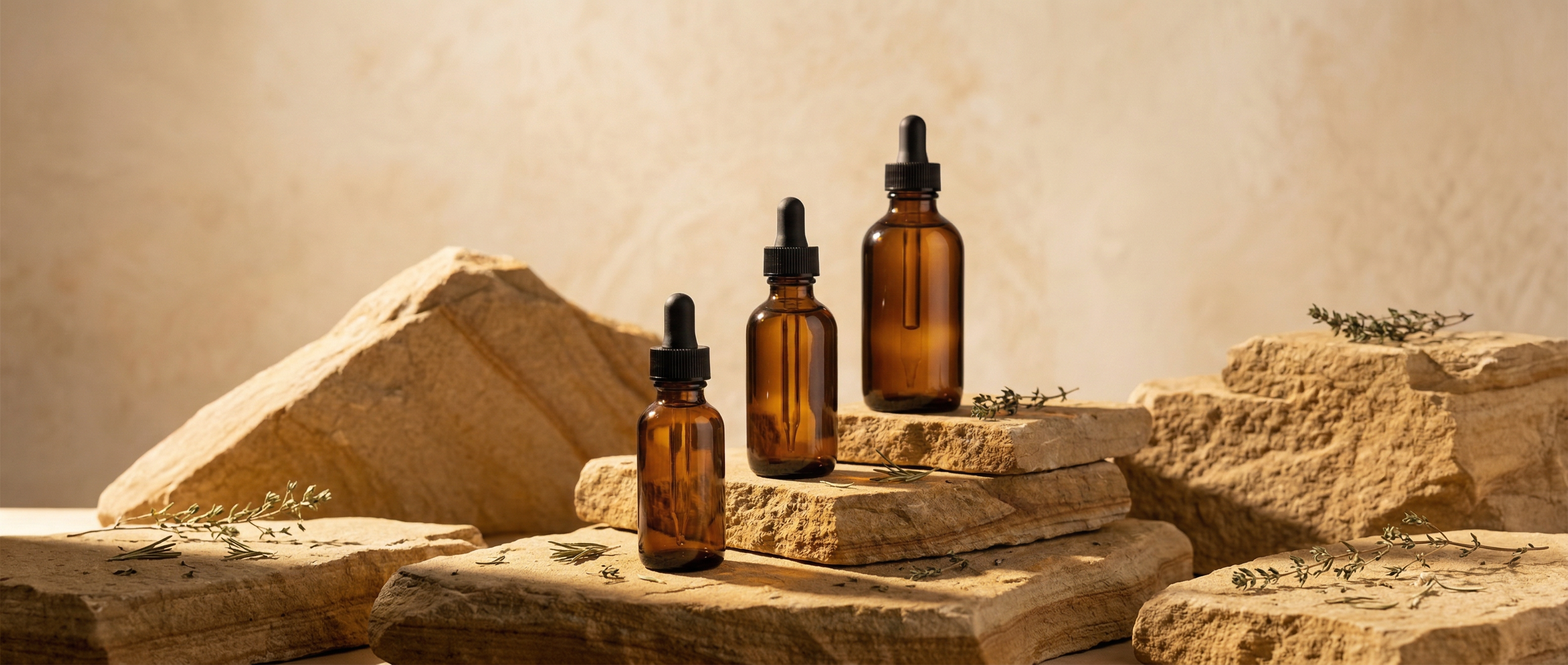
Best Bottles carries both amber and clear glass in multiple neck finishes.
What amber glass actually does: the wavelength range it blocks, what it does not block. Amber glass filters UV in the 300–400 nm range—the wavelengths that degrade many organic compounds. It does not block all light. It is not a substitute for proper storage. But for light-sensitive formulas, it slows degradation significantly.
Products that require it: citrus essential oils, botanical extracts, certain vitamin-based serums. Citrus oils oxidize. Botanical extracts can lose potency. Vitamin C and retinol degrade in light. If your formula contains these, amber or cobalt blue is not optional.
Products that do not: synthetic fragrances, stable oil bases, products with proper preservative systems. Many modern fragrances use synthetics that are stable in clear glass. Mineral oil, squalane, and other stable bases do not need UV protection. If your preservative system is robust, clear glass may be fine.
The cost-benefit: amber glass costs more. Here is when that premium makes sense and when it is wasted money. If your formula degrades, the premium pays for itself in shelf life and customer satisfaction. If your formula is stable, you are paying for a color that does not add function.
Alternatives: cobalt blue glass, frosted clear glass with UV-blocking labels. Cobalt blue filters a different wavelength range; it suits certain formulas. Frosted glass diffuses light but does not block UV. Best Bottles carries amber, cobalt blue, and frosted options. Every product page lists compatible closures. Shop amber glass bottles at bestbottles.com.